
The Cobb test: how to measure your paper's water resistance, step by step
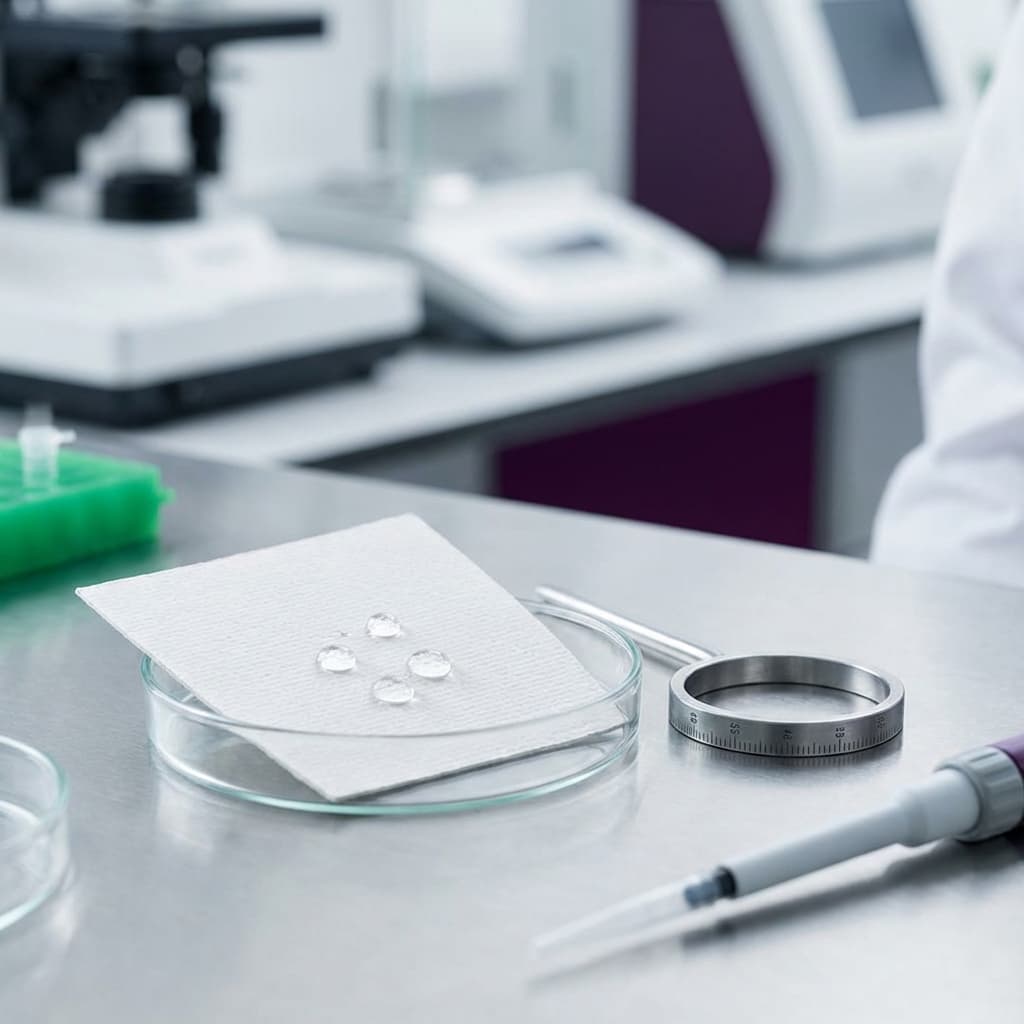
What the Cobb test actually measures
The Cobb test measures how many grams of water one square meter of paper, paperboard, or corrugated board absorbs during a defined period of direct contact with water. The result is expressed in g/m²: the lower the number, the better the barrier. It does not measure visual repellency or water vapor — it measures liquid water absorption, which is what destroys a box's compression strength. It applies to non-bibulous materials (that is, materials that don't soak up water instantly like a blotter).
Lot-to-lot quality control
It's the only objective way to verify that the paper you receive meets the spec you paid for.
Coating validation
Before and after applying a water-based coating, the Cobb value tells you whether the applied coat weight is doing its job.
Early failure detection
A Cobb value that creeps up between shifts usually points to drying or dilution problems before your customer finds them.
Backup against claims
In regulated sectors like food, a per-lot Cobb record is technical evidence, not opinion.

What you need (per TAPPI T 441)
- Cobb tester: 100 cm² metal cylinder with rubber base and clamp
- Metal roller, 10 kg and 20 cm wide (the weight matters: don't improvise)
- Fresh blotting paper for every test
- Stopwatch
- Balance accurate to 0.001 g
- Distilled or deionized water at 23 ± 1 °C
- 100 ml graduated cylinder
The procedure, step by step
- 1
Condition the samples
Leave the samples in a standard atmosphere (23 °C, 50% RH) and cut pieces of 12.5 × 12.5 cm. Paper straight out of a humid warehouse will give you a false Cobb value.
- 2
Weigh dry
Record the weight of each sample to within 0.01 g.
- 3
Mount the sample
Place it on the rubber base with the side to be tested facing up and clamp the cylinder on top. No wrinkles: any leak invalidates the test.
- 4
Pour in the water
100 ml at 23 °C into the cylinder, and start the stopwatch at that exact moment.
- 5
Wait the standard time
120 seconds for paper and paperboard (Cobb₁₂₀); 1800 seconds for corrugated board (Cobb₁₈₀₀). Always report which one you used.
- 6
Remove the water
10 seconds before time is up, pour the water out of the cylinder and release the sample.
- 7
Blot off the excess
Place the sample between two sheets of blotting paper and pass the roller once forward and once back. No pressing: the roller's own weight is the pressure.
- 8
Weigh again
Immediately. Every second you wait evaporates water and flatters the result.
- 9
Calculate
(Final weight − initial weight) × 100 = Cobb value in g/m².
-1.png%3Fwidth%3D566%26height%3D683%26name%3DMedicion-de-la-Resistencia-al-Agua-del-Papel-Metodo-Cobb%2520(1)-1.png&w=3840&q=75)
How to read the result
The five mistakes that skew a Cobb result
- Water at the wrong temperature: every degree outside 23 ± 1 °C changes absorption
- Pressing down on the roller: the procedure uses the roller's weight alone, nothing more
- Reusing blotting paper: damp blotter leaves water on the sample
- 'Approximate' timing: 130 seconds is not Cobb₁₂₀
- Skipping conditioning: the sample's initial moisture is part of the result
Need to calculate your Cobb results?
Download our free Excel calculator with automatic formulas, interpretation table, and step-by-step guide.

Measure before you argue
Half the arguments between converters and paper suppliers would be settled by a properly run Cobb test on the table. If you're going to specify, buy, or sell water barrier, this number is your common language. And if you'd rather skip the math, we have a tool for that.
Download the free Cobb Calculator