
"Water resistant" is not a specification: it's catalog copy. In paper packaging, water resistance has a number — the Cobb value — and not knowing yours costs you money in one of two ways: either you pay for milk-carton-grade barrier on a box that will only ever see condensation, or you design to a Cobb so high your pallets collapse before reaching port. This article is the other half of our Cobb test guide: not how to measure it, but how to decide which one you need.
The Cobb value in 60 seconds
The Cobb value (TAPPI T 441 / ISO 535) measures how many grams of water one square meter of paper or board absorbs in a defined time, usually 120 seconds for paper and 1800 for corrugated. You weigh the dry sample, expose it to a column of water under a standard cylinder, blot off the excess with a 10 kg roller, and weigh again.
- The result is expressed in g/m². Lower number = better barrier.
- If you want the full procedure with the typical lab mistakes, we document it in our Cobb test guide.
The Cobb scale translated into real applications
There is no "perfect" Cobb value. There's the right Cobb value for your product's logistics chain, and it's usually higher (and cheaper) than fear suggests:
- Cobb > 100 g/m²: raw kraft paper or untreated testliner. Fine for dry transit; in contact with water it loses compression strength within minutes.
- Cobb 40-60 g/m²: internal sizing (AKD or rosin). Handles light splashes; saturates under sustained exposure. Common in short-transit agricultural use.
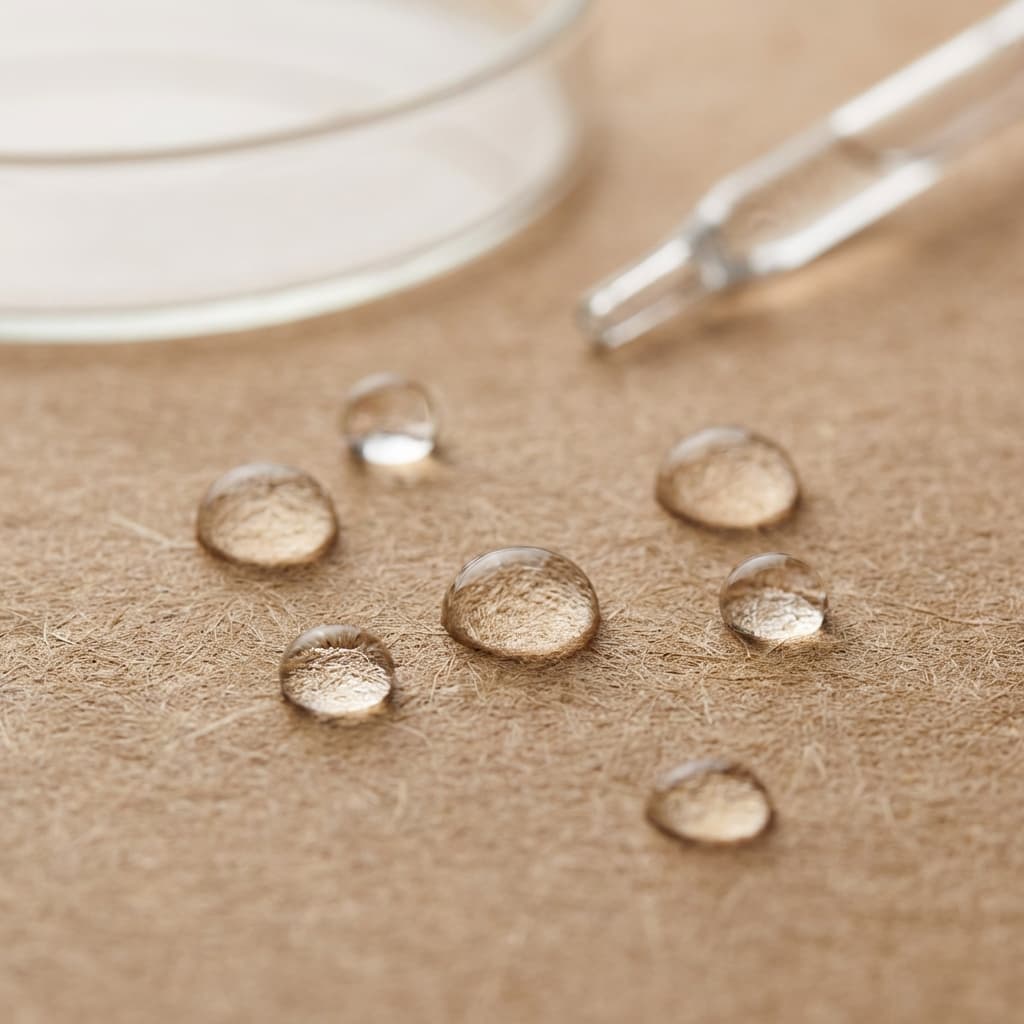
- Cobb 20-30 g/m²: the sweet spot for refrigerated export. Water beads and runs off instead of soaking in. This is where most well-specified agricultural corrugated operates.
- Cobb < 10 g/m²: extreme barrier, the functional equivalent of PE lamination. Required for cups, hot-liquid containers, and ice contact.
The cost of getting it wrong — in both directions
The barrier spec is a financial decision dressed up as a technical one. The two classic mistakes:
- Over-specifying: calling for Cobb 5 where the box needs Cobb 25 inflates coating cost by 15 to 30%, shift after shift, and nobody notices because "the box works".
- Under-protecting: shipping broccoli with crushed ice in Cobb 45 boxes guarantees pallet collapse. The loss from a single rejected shipment usually exceeds a full year's savings on coating.
Your fiber decides how much coating you need
The same coating, at the same coat weight, gives different Cobb values depending on the substrate. The sheet's porosity determines how much product stays on the surface doing barrier work and how much is lost into the sheet:
- Kraftliner (virgin fiber): closed structure, needs fewer grams per m² to seal the surface.
- Testliner (recycled fiber): porous and variable between lots. It soaks the coating into the matrix (soak-in) and demands heavier films or formulations with high surface retention (hold-out) — which is exactly what the lines we work with at Coaterex are formulated for.
Why your lab Cobb value doesn't always survive to the field
A certificate showing Cobb 20 protects nothing if the converting process breaks the film. Three points where the "real" Cobb value degrades:
- Scoring and folding: the crease can microfracture rigid coatings. Water gets in at the box edges, exactly where the structural load is highest.
- Insufficient drying: water-based coatings need to evaporate the carrier and reach their crosslinking temperature. If the oven runs short on temperature, you can apply twice the product and still measure a high Cobb value.
- Abrasion in transit: vibration between boxes erodes thin films. If your route is long and the stacking tight, factor it into the coat weight.
Cobb is not MVTR (and confusing them gets expensive)
They're the two most-used moisture metrics and they measure different things. Specifying the wrong one wrecks performance even though they "sound like the same thing":
- Cobb (TAPPI T 441): liquid water. Rain, melting ice, severe condensation. It's what keeps the box from falling apart.
- MVTR (TAPPI T 464): water vapor. How much gaseous moisture crosses the barrier over time. It's what keeps the cracker from going soft or the dry product from picking up moisture — even if the box never touches liquid water.
Test, don't guess
Our job at Coaterex isn't to sell you the heaviest coating: it's to help you set the target Cobb value based on your real logistics conditions, measure your current substrate, and formulate to hold that number on your machine, shift after shift. Getting started is simple: calculate how much water your paper is absorbing today.