
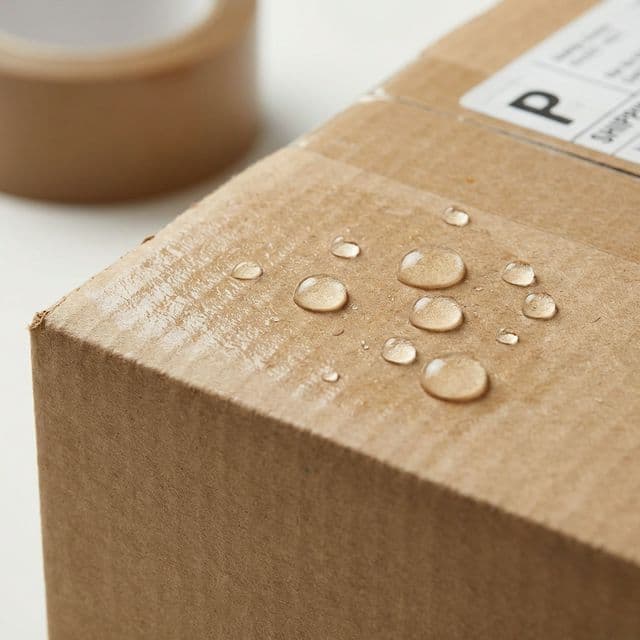
Almost no corrugated plant fails the migration to water-based barriers because of the chemistry. They fail because of the methodology: testing too many variables at once, scaling too early, or validating with the wrong SKU. The pressure to migrate is real — the European PPWR, the 2025-2030 targets of major brands, the EPR schemes already penalizing non-recyclable packaging — but a well-run migration doesn't require stopping production or buying equipment. It requires method. This is the one we use.
The Strategic moment for sustainable corrugated
Regulation is no longer a future threat
The PPWR requires all packaging sold in the EU to be effectively recyclable by 2030, and extended producer responsibility schemes in France, Germany, and several Latin American countries already charge for non-compliant packaging. If you export, the clock is already running on you.
Premium contracts demand certifiable papers
Fresh food, frozen food, and sustainable e-commerce pay better margins — and their buyers ask for repulpability evidence, not promises. A box with a certifiable water-based barrier opens doors that a waxed box closes.
Genuinely mono-material
Unlike laminate, corrugated board with a water-based barrier enters the standard recycling stream: the film dissolves in the hydrapulper along with the fiber. That's what PTS testing verifies, and what your customers can claim without greenwashing risk.
Your current equipment will do
Modern formulations run on the flexographic and anilox roller systems you already have. The investment is technical hours and process discipline, not capital.
Roadmap: 5 stages to a Risk-Free implementation
- Define the KPI before touching the machineIced broccoli box or delivery box? The end use sets the metrics: target Cobb value, MVTR if there's a cold chain, wet ECT. Without a target number, there's no way to declare success or failure.
- Validate in the lab firstWorking viscosity, dilution, and dry coat weight get defined on your paper, in the lab. Every hour of lab work saves a shift of trial-and-error on the machine.
- Run a short, controlled pilotOne scheduled shift, one SKU, one technician dedicated to recording. What gets monitored: film uniformity and drying behavior under real conditions.
- Test the box where the box failsPalletized, in the cold room, with final printing. The lab Cobb value is necessary but not sufficient: validation is logistical, not just chemical.
- Standardize before you scaleViscosity, temperature, and speed ranges in writing, operators trained, and only then full production. Shift-to-shift consistency is what separates a successful trial from a reliable process.
Pre-Production checklist: Success is in the details
Before the first run, verify these four points. Each one has a known failure mode attached to it:
- Application system: clean anilox rolls and pulse-free pumping. A clogged anilox produces stripes of high Cobb value that nobody sees until the claim arrives.
- Drying capacity: water demands 20-40% more drying energy than the systems it replaces. If the oven can't keep up, the film won't crosslink and the barrier doesn't exist.
- Chemical compatibility: validate adhesion with your current inks and adhesives. Picking on press is the classic symptom of skipping this step.
- Ambient conditions: room temperature and humidity shift the operating window. Log both during the pilot so you can reproduce it.
Quality protocols: Measure what actually matters
| Cobb (TAPPI T 441) | The central metric: <35 g/m² for fresh produce, <20 g/m² for frozen. Sample by shift, not by purchase lot. |
|---|---|
| 3M Kit Test (TAPPI T 559) | If greasy foods are at the destination, Kit 8 or higher. Fluorine-free: that's what sets this generation of coatings apart. |
| MVTR | For extended cold chain: <100 g/m²/day maintains structural integrity in the container. |
| Convertibility | Clean die-cutting and gluing >2 N/25mm. A perfect barrier that won't glue is a box that doesn't exist. |
Low-Impact pilot: How to trial without hurting your Output
- Pick a SKU of medium complexity and moderate volume. Not the easiest (it proves nothing) and not the most critical (it forgives no mistakes).
- Schedule it on a light-load shift, with room to adjust without shipping pressure.
- Assign someone to own the record: viscosity, coat weight, temperatures, Cobb results. What isn't documented can't be reproduced.
- Define the acceptance criteria before turning on the machine, not after seeing the results.
- Follow the box all the way to the end customer: performance at destination is the only verdict that counts.
Avoid these costly migration mistakes
- Trying to validate everything in one run. The learning curve is real; plan for two or three iterations.
- Changing the chemistry and the machine parameters at the same time. When something fails — and something will — you won't know which one it was.
- Leaving operators and maintenance out of the project. They're the ones who will sustain the process after the technician leaves.
- Scaling on a good pilot without defined operating ranges. A good result without a documented process is luck, not capability.