
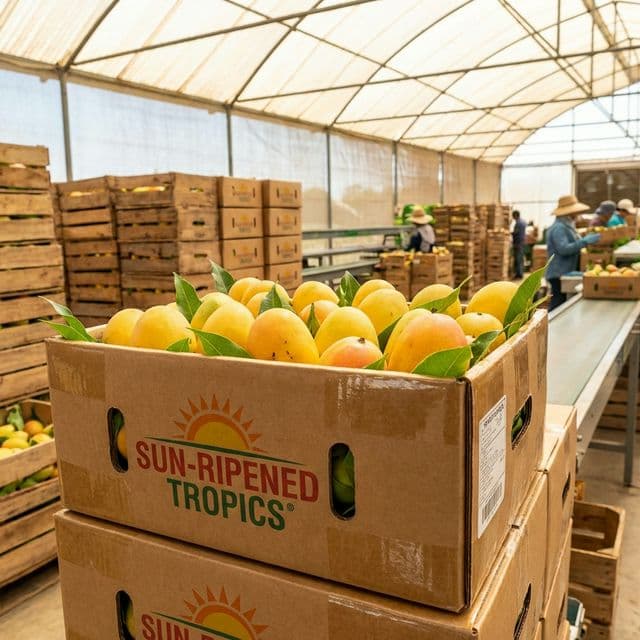
Most boxes don't need to survive immersion. They need to withstand three weeks of container humidity, cold-room condensation, and the occasional splash — consistently, and at a cost that doesn't eat the margin. For that job, which is 80% of barrier-coated corrugated, buying the most powerful chemistry in the catalog is throwing money away. HydraBan® is formulated exactly for that 80%: reliable water barrier at the lowest cost per treated square meter.
What it is and how it works
HydraBan® is a water-based acrylic resin shipped ultra-concentrated and diluted at the plant — up to 90% in water depending on the application — before being applied to kraft, liner, or fluting. With the heat of the corrugator or the drying oven, the polymer crosslinks and forms a continuous hydrophobic film that blocks liquid water and reduces vapor transmission.
- Chemistry: high-dilution acrylic resin, free of organic solvents and PFAS.
- Maximum dilution: up to 90% in water, depending on application and paper basis weight.
- Drying: compatible with standard corrugator systems (120-180 °C).
- Working viscosity: adjustable between 20-80 cP depending on the application system.
Dilution changes the cost model, not just the price
A conventional coating is bought nearly ready to use: you pay freight and warehousing for water. HydraBan® travels concentrated and your plant supplies the water. The consequences compound at every link:
- Freight: shipping concentrate instead of diluted product multiplies payload by 6-8.
- Warehousing: one 1,000 kg IBC of concentrate is operationally equivalent to 6,000-8,000 kg of ready-to-use product.
- Cost per m²: with a dry coat weight of 3-6 g/m² and high dilution, the cost per treated square meter lands among the lowest on the market.
- Supply: fewer inventory turns and lower stockout risk.
The numbers, no embellishment
The obvious question with a high-dilution product is whether it performs the same. In the range it's formulated for, yes — and that range is documented, not implied:
- Cobb (TAPPI T 441): 22-28 g/m² under standard application conditions.
- Wet compression: boxes retain 85-95% of their original BCT after exposure to 85% RH.
- MVTR: reduction sufficient for standard refrigerated transport.
- Cold chain: stable between 2 °C and 10 °C.
- Repulpability: certifiable under the PTS-RH 021/97 method; does not affect fiber recovery.
Where it's the right choice
Over-specifying barrier is the most expensive and quietest spec mistake in corrugated. HydraBan® is the answer when the risk is ambient humidity and splash, not immersion:
- Standard agricultural export (bananas, pineapple, citrus) in refrigerated containers.
- E-commerce boxes in tropical climates: warehouse condensation and a wet last mile.
- Cut flowers: high cost sensitivity, moderate Cobb value is enough.
- Iced poultry: high humidity without prolonged liquid contact.
- Industrial packaging: moisture protection in storage and transit.
When it's NOT the product (and what to use instead)
We'd rather say it ourselves before your line does: if you need a Cobb value below 20 g/m², simultaneous grease barrier, or prolonged exposure to free water, HydraBan® is not the choice. The right routes within the portfolio:
- Michem® Coat: Cobb 10-20 g/m², for fruit with high surface moisture like grapes or tomatoes.
- VaporCoat®: Cobb <10 g/m² with grease resistance (Kit 8-12), for food service, frozen foods, and extreme cold chain.
- Combined water + grease formulations: trays and boxes for fresh protein or seafood.
It runs on the machine you already have
HydraBan® is formulated for the application systems already in place across Latin American corrugated plants. The list of validated configurations:
- Anilox roller on the single facer or double backer.
- Converted gluing station, with minimal doctor blade modifications.
- Flexographic blade coating for precision coat weight on offline presses.
- Spray systems on formed boxes, in specific configurations.
- Speeds of 100-350 m/min with no changes to the drying system.
How to make the case to finance
The internal argument has two columns: direct savings (less product lost, fewer rejections at destination, lower cost per protected m²) and avoided risk (claims, contractual penalties, business relationships damaged by boxes arriving in bad shape). To size it with your own numbers:
- Take your current rejection rate from box failure and the value of the affected goods: that's the cost the barrier attacks.
- The cost of the coating typically pays for itself through reduced losses within the first weeks of production — the exact math depends on your product and your route, and we work it out together during the audit.
- Add the commercial upside: boxes that arrive at retail looking presentable, and repulpable packaging your customers can certify.
Implementation is not trial and error
Every HydraBan® implementation starts with data and ends with an operating protocol, not a 'that should do it':
- Line audit: application system, speed, drying, and paper define the exact dilution.
- Lab first: Cobb and MVTR measured on your paper before the plant trial.
- Supervised pilot: a Coaterex technician on-site for the first run, logging viscosity, coat weight, and Cobb value in real time.
- Process protocol: documented operating ranges for every shift.
- Support: formulation adjustments at no cost during the first 90 days of production.
The best barrier isn't the most impermeable one: it's the one that hits your target Cobb value at the lowest cost per square meter, shift after shift. If your operation lives in the Cobb 22-28 range, HydraBan® is probably that barrier — and the way to know for sure is to test it on your own paper.