
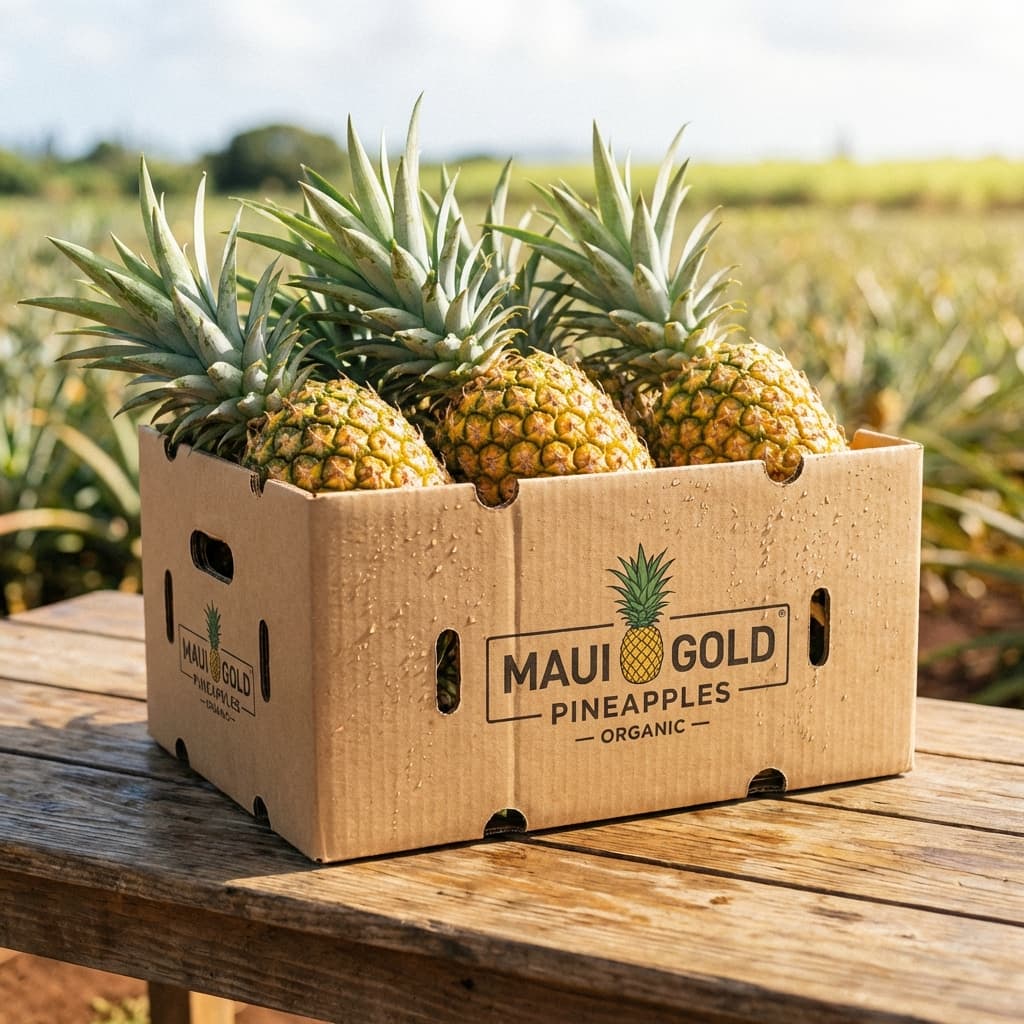
A box of bananas packed in Ecuador can spend three weeks in transit to a supermarket in Germany, inside the most destructive environment paper can face: sustained 90% relative humidity and constant refrigeration. The box doesn't fail from impact or bad structural design — it fails because the paper, molecule by molecule, surrenders to water vapor. This article explains that failure in detail: what happens inside the container, which metrics you should demand before specifying, and how it gets solved today without sacrificing recyclability.
Humidity + cold: the combination that beats paper
Paper is hygroscopic: its cellulose fibers naturally attract water. Dry, kraft is surprisingly strong and supports several times its weight in vertical compression. But in the relative humidity of a refrigerated container — 85 to 95%, fed by the respiration of the fruit itself — the fibers absorb vapor, swell, lose their hydrogen bonds, and structural strength falls off a cliff:
- At 85% RH, uncoated kraft can lose up to 40% of its compression strength (BCT) within the first 24 hours.
- At 95% RH — normal conditions in banana containers — the loss can exceed 60% in 48 hours.
- Boxes at the bottom of the pallet take a double beating: more condensation from the floor and more vertical load on top. That's where almost every failure starts.
- And when a bottom box gives way, the whole pallet collapses in a cascade. You don't lose one box: you lose the shipment.
Anatomy of a failure: day by day inside the container
To make a sound protection decision, it helps to see the deterioration for what it is — a gradual process with a predictable timeline:
- Hour 0, packing at the plant: the box leaves with its nominal strength. 12-14 °C, 60-70% RH.
- Hours 6-24, container loading: fruit respiration drives RH to 85-95%. The outer boxes on the pallet start absorbing vapor.
- Days 3-7, at sea: absorption progressively saturates the fiber. The box loses stiffness; the corners — which carry the weight — give way first.
- Days 10-14, arrival at port: the bottom boxes have lost 30-50% of their BCT. The quality inspector rejects the pallet.
- The final cost isn't just the fruit: it's selling at a markdown, the contractual penalty, and the eroded business relationship.
Why wax and PE stopped being the answer
The industry has already solved this problem twice — with waxed boxes and with polyethylene laminate — and both solutions lost their license to operate, for different reasons but with the same ending:
- Waxed boxes: excellent barrier, zero repulpability. Most recycling plants reject them, and they're restricted in European markets and, increasingly, in Latin America.
- PE laminate: comparable barrier, same underlying problem. The plastic jams hydrapulpers and contaminates the recovered fiber.
- Both complicate gluing with cold-set and hot-melt adhesives: weak joints, manufacturing failures.
- And neither meets the recyclability standards of the European PPWR or the requirements of major retailers with sustainability targets.
The current solution: repulpable water-based barrier
Water-based coatings attack the moisture without creating the recycling problem. They're applied to the paper right on the corrugator, form a hydrophobic film on drying, and that film dissolves with the fiber during repulping. The result: board with a real, measurable, certifiable barrier.
- Cobb 20-28 g/m² with HydraBan® for standard agricultural export: bananas, pineapple, citrus.
- Cobb 10-18 g/m² with Michem® Coat when the fruit carries high surface moisture: grapes, strawberries, tomatoes.
- Sustained BCT: the design target is retaining more than 85% of original compression after 72 hours at 85% RH.
- Gluing unchanged: compatible with standard cold-set and hot-melt adhesives.
- Repulpability certifiable via the PTS-RH 021/97 method, verifiable by an independent lab.
An example with numbers (illustrative, using typical industry values)
To size what's at stake, consider a representative export operation: weekly shipments of 1,000 pallets to Europe, 14-18 day transits at 12-14 °C and 90-95% RH, boxes made of 125-150 g/m² recycled kraft. In operations like that, rejection rates at destination from structural box failure typically run between 3 and 5%:
- At a 4% rejection rate on 1,000 weekly pallets, you lose 40 pallets of fruit per week — plus freight, inspections, and penalties.
- A well-specified barrier (target Cobb ~25 g/m², applied at 3-5 g/m² dry on the corrugator) attacks the root cause of that loss head-on.
- The coating cost per box is a small fraction of the value of the fruit it protects: that's why the payback is measured in weeks, not years.
- The exact number depends on your paper, your route, and your fruit — and the only honest way to get it is to measure your operation, not copy the industry average.
The six metrics you should demand with the sample
Not every coating sold as 'water resistant' comes with evidence. Before specifying, ask for this data — measured on your paper, not on the ideal paper in the catalog:
- Cobb value (TAPPI T 441 or ISO 535) at your application coat weight and with your drying system.
- BCT under humidity: compression measured after 24-72 hours at 85-95% RH, not just under dry conditions.
- MVTR: vapor transmission per m²/day, relevant for extended cold chain.
- PTS-RH 021/97 repulpability certificate or equivalent, from an accredited lab.
- Gluing compatibility with your plant's specific adhesives.
- Indirect food contact suitability, depending on product and destination market.
The implementation path: 4 to 8 weeks
Moving from an uncoated box — or a waxed one — to a repulpable water-based barrier typically takes 4 to 8 weeks from audit to stable production. Here's what the process looks like with Coaterex:
- Week 1: line audit and lab trial with your paper and your drying system.
- Weeks 2-3: formulation, dilution, and parameters defined; technical data delivered before touching the machine.
- Week 4: pilot run with a Coaterex technician on-site; sampling of Cobb, BCT, and MVTR.
- Weeks 5-6: fine-tuning and a second validation run if needed.
- Weeks 7-8: full-scale production with a documented protocol and the repulpability certificate in hand.
- Afterward: tracking results at destination and seasonal adjustments — December humidity is not July humidity.