
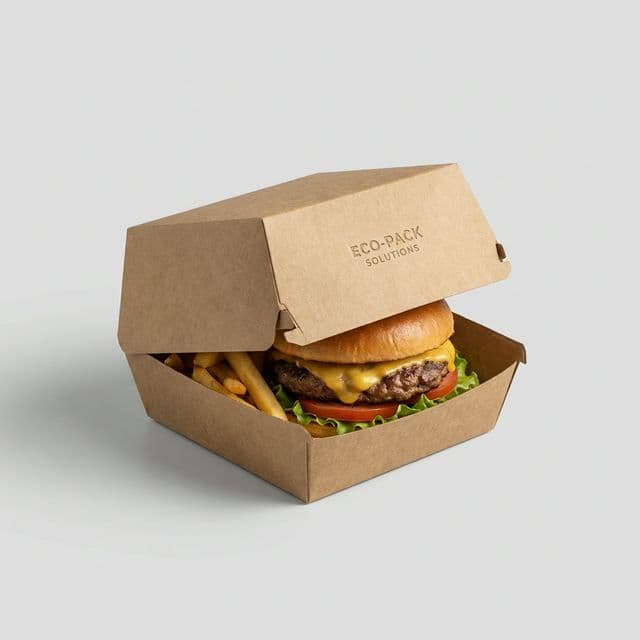
For half a century there was an unwritten rule in packaging: for water, wax or polyethylene; for grease, fluorochemicals; and if you needed both, budget for a multilayer structure impossible to recycle. The rule had a real basis in surface physics — it wasn't formulator laziness. But it's no longer true. This article explains why the dilemma existed, what solved it, and how a genuine dual barrier is measured.
Where the myth came from: two liquids, two physics
Water and grease attack paper in opposite ways. Water is polar with high surface tension (~72 dynes/cm); oils are non-polar with low surface tension (20-30 dynes/cm). That forced contradictory strategies:
- Repelling water requires a non-polar surface: waxes and PE do it very well — but aggressive greases dissolve or degrade them.
- Repelling grease means dropping the paper's surface energy below the oil's: historically only fluorochemicals (PFAS) managed that efficiently.
- Mixing both approaches in one formulation produced chemical instability, or a barrier that failed against one of the two fluids.
What solving the dilemma the old way cost
The three historical solutions to the dual barrier carry trade-offs that are unacceptable today — both regulatorily and commercially:
- PE extrusion: solved both barriers and turned the package into non-repulpable waste, headed for landfill or incineration.
- PFAS, the 'forever chemicals': unbeatable against grease, persistent in the environment, bioaccumulative, and now restricted or banned for food contact in a growing number of markets.
- Aluminum lamination: expensive, carbon-intensive, and complicated to recycle.
What changed: crosslinked films that seal, not just repel
The current generation of coatings — our VaporCoat® series among them — depends on neither PE nor fluorine. They're advanced polymer emulsions, typically modified acrylics or biopolymers, that form a continuous film on drying. The conceptual shift is in the mechanism:
- Mechanical pore sealing: instead of impregnating the fiber like traditional sizing, the film covers the surface and closes the liquid's physical path.
- Oleophobicity without fluorine: the dense film blocks lipids by physical obstruction, not by surface tension differential. The PFAS trick stopped being necessary.
- Thermal crosslinking: with the heat of the corrugator or the oven, the polymer chains interlock (crosslinking) and the resulting network resists both cold and hot fluids.
"Dual barrier is hard to run": the other myth
The second classic objection is operational: that these coatings are viscous, foul the machine, and cause roll blocking. That was true with older chemistries; with current formulations, it isn't:
- Controlled viscosity: they flow through anilox rolls, gluing stations, and doctor blades with no special treatment.
- No blocking: the crosslinked film isn't tacky; reams and rolls don't stick together in storage.
- Convertibility intact: coated paper die-cuts, folds, and glues at normal speed on conventional lines.
How a genuine dual barrier is measured: Kit and Cobb, separately
A serious dual barrier is demonstrated with two independent numbers, measured on the same coated substrate. If your supplier only gives you one, ask for the other:
- Cobb (TAPPI T 441) for water: absorption in g/m² over the standard time. For a demanding dual barrier, the target is Cobb <15 g/m², ideally <10.
- Kit (TAPPI T 559) for grease: repellency against progressively aggressive mixtures of castor oil, toluene, and heptane. Kit 8-12 indicates robust resistance to dense greases, even hot ones.
Where a single barrier guarantees failure
Not every package needs duality — and where it isn't needed, paying for it is over-specifying. But on these three fronts, saving money with a single barrier is buying the claim in advance:
- Food service and delivery: hot grease on the inside, steam condensation everywhere, and the critical 30 minutes of home delivery.
- Raw protein (chicken, beef, seafood): refrigeration at sky-high RH, product fluids, and organic fats, all at once.
- Industrial packaging for auto parts and metals: parts coated in protective greases, outdoor transit, rain, and port humidity.
The regulatory and ESG dividend
Migrating the dual barrier to fluorine-free water-based chemistry doesn't just solve performance; it puts the compliance file in order:
- PFAS-free: ahead of European restrictions (REACH) and the state-by-state regulatory wave in the US.
- Circulating fiber: at coat weights of 3-8 g/m², plant trim and post-consumer boxes achieve full fiber recovery in conventional hydrapulpers, certifiable via PTS.
- Less weight than a laminate: same function with less material, which lowers the fees under EPR extended responsibility schemes.
Testing it costs you a sample
The water-or-grease dilemma was settled in the lab, but every application is won on the machine. We formulate the VaporCoat® and Michem® Coat series for your packaging's real parameters — the type of grease, the temperature, the exposure time, and the substrate — and we prove it with Kit and Cobb values measured on your own paper, before you change anything in production.